
The Book Is Out. Here Is Why the Argument Still Matters.
By Michael McClellan · President, Collaboration Synergies Inc · Camas, Washington
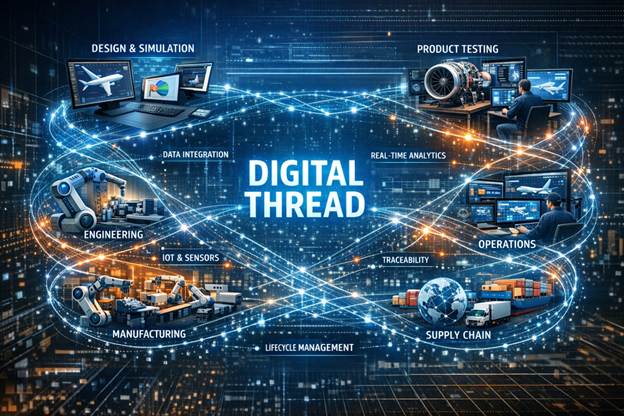
Six months ago I published an article on this platform arguing that manufacturing AI is missing its foundation. The response confirmed what four decades of plant work had already taught me: the problem is recognized, widely felt, and largely unaddressed.
Since then, I have published the book — The Intelligent Digital Thread: How AI, AI Agents, and Real-Time Data Create Autonomous Manufacturing Systems. Seventeen chapters. The full architecture, the economics, and the implementation path. The conversations that followed — with plant leaders, manufacturing IT directors, and technology vendors — have sharpened several points and left the central argument intact.
That argument is worth restating, because the landscape has not changed. The pilots still look impressive. The scale-up still disappoints. And the diagnosis is still almost always wrong.
1 · The Diagnosis Everyone Gets Wrong
Ask a vendor why your AI initiative is underperforming and they will tell you: data quality problems. Change management resistance. Integration complexity. Budget constraints.
These are real. But they are symptoms. The root cause is something the industry has not yet named clearly, and it is architectural.
AI learns from what actually happened. Not from what was planned. Not from system-of-record snapshots. Not from aggregated production summaries. From what actually happened — specifically, to a specific product, at a specific production step, under specific conditions, at a specific moment in time.
That specific record is called the production digital thread. And in most manufacturing environments, it does not exist in coherent, accessible form.
It is not that the data is not generated. It is generated, at every workstation, every shift, for every item. The problem is that it was never captured, linked, and preserved as a coherent, item-specific record.
ERP captures transactions. MES captures execution events. PLM captures design intent. Quality systems capture inspection results. Each holds a fragment. None captures the complete, item-specific thread that connects them in the sequence the product actually experienced.
The technical term for what is missing is data continuity — an unbroken, item-specific record that follows a product from first operation to last, carrying every data artifact generated along the way. Without data continuity, you have data. With it, you have a thread. That distinction is the difference between AI that plateaus and AI that compounds.
2 · What the Production Digital Thread Actually Is
The production digital thread is not an abstract concept. It is a specific, operational artifact with a precise definition:
The complete record of what was planned and what actually happened for each manufactured item, at each production step, including every data artifact associated with that step.
Two words in that definition carry most of the weight: item-specific.
The thread does not belong to a product family. It does not belong to a production run. It belongs to one work order, one serial number, one batch — moving through a sequence of production steps in a specific order, generating specific data at each step. The material it came from. Who touched it. What the machine actually did. What was measured. What was corrected. What decision was made when something deviated.
By the time the item ships, the thread is a complete, step-by-step biography of how that specific product came to exist. That is data continuity — not a snapshot, not a summary, but the unbroken record of every step in sequence.
That continuity is what makes AI tractable at the operational level. An agent at step seven does not need to understand the entire production environment. It needs to understand this item’s thread so far, what this step requires, and whether what is happening matches. That is a bounded, solvable problem. And it becomes more solvable with every additional item instance that builds the record.
3 · The Bill of Process Information — Making It Executable
Every manufactured product has this information somewhere. The engineering team knows what should happen at each step. The process engineers know what parameters matter. The quality team knows what needs to be measured. The operators — particularly the experienced ones — know the things that are not written down anywhere: the quirks of a specific machine on the third shift, the material lot that always runs slightly different, the correction that experienced hands apply automatically.
I call that unwritten knowledge lore. It is real, it is operational, and it walks out the door every time a senior operator retires.
The Bill of Process Information — the BOPI — is the mechanism that makes this executable. It defines, for each production step: what information is required at this workstation for this product, where it comes from, what gets collected, and what decisions govern the transition to the next step. It is not a document. It is a process model, executed by a BPM engine against a specific item instance.
When the BPM engine executes the BOPI for a specific work order or batch, two things happen simultaneously: the right information is delivered to the right workstation at the right moment for that specific item, and the record of that delivery — plus everything collected in return — is preserved as the thread for that instance.
The thread is not built as a separate documentation step. It is built as a natural byproduct of execution. Every item that moves through the process builds its own thread automatically.
4 · Where AI Agents Enter
With a complete, current, item-specific thread available at each production step, AI agents have something they rarely have in manufacturing today: ground truth in real time.
An agent monitoring the executing thread watches for the moment when what is actually happening deviates from what was planned. When that deviation occurs — a measurement outside tolerance, a parameter drift, a missing artifact, an unexpected material lot — the agent does not see an isolated data point. It sees that event in the context of everything that has happened to this specific item at every prior step.
That context is what enables useful operational decisions. Has this pattern appeared before? At which step? Under which conditions? What was done? What was the outcome? The accumulated thread records across previous item instances contain that knowledge. The agent retrieves it, applies it, and acts — recommending a disposition, adjusting a downstream step, escalating to a human when the situation is outside its experience.
The sophistication of that response evolves deliberately over time through what the book calls bounded autonomy — a disciplined, measurable, reversible expansion of agent authority. Early deployments: the agent surfaces the anomaly with full context, the human decides. As thread records accumulate and agent performance is validated: the agent handles defined exception classes within explicit boundaries. Over time, as the record deepens and confidence builds: those boundaries expand — but always under governance, always reversible, always earned through demonstrated performance on a growing body of item-specific thread evidence.
Bounded autonomy is not a concession. It is the architecture that makes trust computable. Each expansion of the agent’s decision boundary is backed by specific thread evidence, approved by specific human authority, and reversible if performance degrades. That is how you build production-grade confidence — not by declaring autonomy, but by earning it increment by increment.
5 · The Compounding Return
Here is the argument that should matter most to anyone accountable for manufacturing AI investment:
The thread record is not just an operational tool. It is a proprietary strategic asset that appreciates with every production run.
Every item instance executed builds the thread. Every thread record adds to the lore — the accumulated, specific knowledge about how your products behave at your production steps under your conditions. Every increment of lore improves AI agent performance. The system gets smarter as it operates, in a way that is specific to your products and processes and cannot be replicated by a competitor or purchased from a vendor.
Generic AI capability is increasingly commoditized. Foundation models are available to everyone. Data continuity — the unbroken, item-specific execution record that those models need to be useful in your specific manufacturing context — is not available to everyone. It is yours, if you build the architecture to capture and preserve it.
The manufacturer who builds the most complete, most accurate, most consistently captured thread record has a learning asset that compounds over time. The AI investment does not fail. It appreciates.
There is also an organizational argument that is underappreciated. Manufacturing knowledge has always been vulnerable to personnel turnover. When the senior process engineer retires, the lore goes with her. When the long-tenured operator leaves, the workarounds and the intuitions and the corrections that never made it into any work instruction leave with him.
The thread record is the mechanism for preserving that knowledge formally — not as a documentation project, but as a natural byproduct of production execution. Every anomaly captured, every disposition recorded, every correction written back into the thread is lore made permanent. The AI learns from it. The next operator benefits from it. The organization retains it.
The Conversation the Industry Needs to Have
The production digital thread is not a new idea. The Bill of Process Information has been the core of my advisory practice for 25 years. BPM engines capable of executing production process models exist today. The integration patterns are understood. The AI agent frameworks are maturing rapidly.
What has been missing is the enterprise-wide organizational will to treat the thread as infrastructure — not an IT project, not a plant floor initiative, but a cross-functional commitment to capturing what actually happens to specific products at specific steps as a permanent, queryable, AI-accessible record.
That commitment requires IT to care about what happens at the workstation level. It requires operations to care about the data architecture that surrounds each step. It requires executive leadership to recognize that the ROI from AI investment is directly proportional to the completeness of the execution record that AI has to learn from.
Every manufactured product has this information somewhere. The question is whether your organization is capturing it, preserving it, and making it available to the AI systems you are investing in. If the answer is not yet, that is the most important thing to fix — not the AI models, not the algorithms, not the dashboards.
The foundation first. The intelligence follows.
Michael McClellan is President of Collaboration Synergies Inc (CSI), an independent manufacturing advisory firm based in Camas, Washington. He is an originator of Manufacturing Execution Systems (1984), author of Applying Manufacturing Execution Systems (CRC Press, 1997), former Board member of MESA International, and presenter at the NIST MBE Summit (Chicago, 2024). His latest book, The Intelligent Digital Thread: How AI, AI Agents, and Real-Time Data Create Autonomous Manufacturing Systems, is available now.
mm@cosyninc.com · productiondigitalthread.com
#Manufacturing #AI #DigitalThread #IntelligentDigitalThread #ManufacturingAI #BOPI #MES